



Traditional workforce planning was built for a more stable environment. Business models stayed steady. Roles changed slowly. Skills remained relevant for years. Technology adoption was almost sluggish and followed predictable curves. Planning cycles could span multiple years with only incremental adjustments.
That world no longer exists. AI introduces three forces that fundamentally undermine legacy workforce planning approaches.
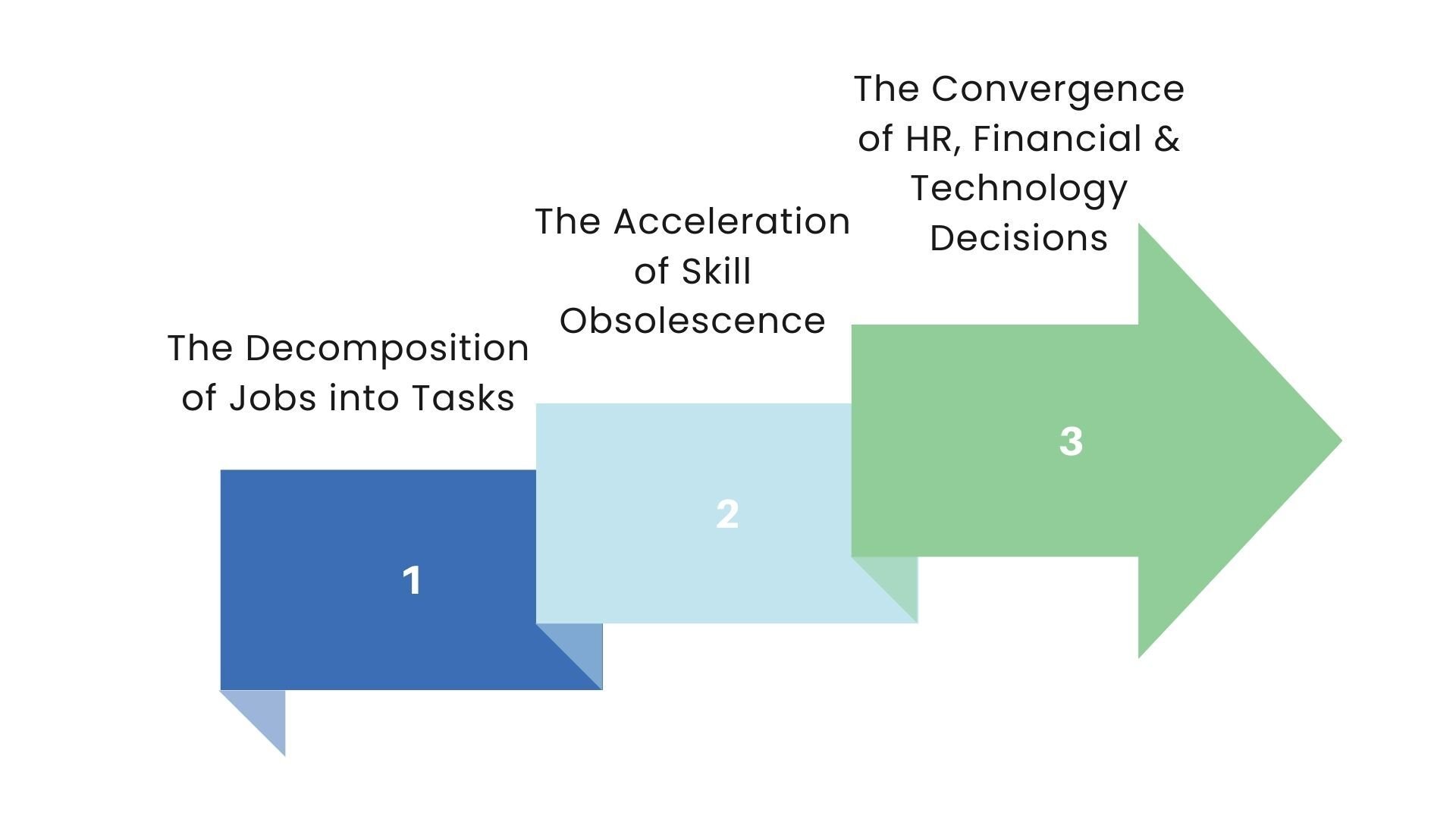
1. The Decomposition of Jobs into Tasks
AI does not replace entire jobs all at once. It automates and increasingly augments specific tasks within jobs. This makes job-level planning insufficient.
Organizations must understand:
● Which tasks are performed today
● Which tasks can be automated or augmented by AI
● Which tasks require uniquely human capabilities
Without this level of granularity, workforce plans become blunt instruments in an environment that requires precision and pace.
2. The Acceleration of Skill Obsolescence
The half-life of skills has dropped from ten years to less than four, and it is still shrinking. Technical skills may become outdated in as little as two to three years. IBM estimated that 40% of their workforce will need to reskill as a result of the implementation of new technologies in the next three years.
If applied to the global workforce, that would mean 1.4 billion workers will need to continuously reskill.
AI accelerates this trend by:
● Automating routine cognitive work
● Shifting demand toward analytical, creative, and judgment-based skills
● Creating entirely new skill categories faster than organizations can define them
Static skills frameworks and annual workforce plans simply cannot keep pace with the sheer frequency and volume of change.
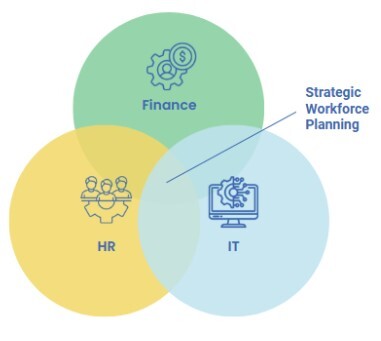
3. The Convergence of HR, Financial, and Technology Decisions
AI investments are not purely technology decisions. They have direct implications for:
● Labor costs, productivity and budgeting (CFO)
● Workforce capacity, organizational design and capability (CHRO)
● Architecture, data, and governance (CIO)
When SWP is disconnected from financial and technology planning, organizations make fragmented decisions that optimize one dimension at the expense of others.
The Time is Now
Perhaps the most dangerous assumption organizations can make is that they have time. They do not. AI adoption is accelerating faster than most workforce strategies can adapt.
Organizations that delay will face:
● Critical skill shortages
● Rising labor costs with declining productivity
● Increased reliance on expensive external hiring
In the age of AI, SWP is not about predicting the future perfectly. It is about anticipating a variety of scenarios and acting quickly and confidently. Organizations that shed their antiquated strategies in favor of contemporary technologies and techniques will adapt faster than (and outperform) their competitors.
A Call to Action
The AI wave is not temporary. It will not reshape work at a comfortable pace. It will force organizations to confront fundamental questions about how value is created, and by whom (or what). Strategic workforce planning is the discipline that connects these questions to action. But only if it evolves.
Organizations must:
● Abandon static, role-based planning
● Embrace new ways of tracking and evaluating skills, tasks, and scenarios
● Leverage AI to automate administration and augment human decision-making
● Align HR, Finance, and IT around a shared workforce strategy
Management guru Peter Drucker suggested, “the best way to prepare for the future is to create it.”
If you are looking to merely survive the AI tsunami, you will undoubtedly find yourself underwater. So grab a surfboard (and a strong SWP partner) and ride the wave into the future.

About LYTIQS
LYTIQS helps organizations navigate this new reality. Our AI-enabled workforce analytics and strategic workforce planning solutions empower leaders to understand their workforce at a deeper level, model future scenarios, and make confident, data-driven decisions in an era of unprecedented change. The future of work is already here. Are you ready?
About Marcus Mossberger
Marcus is genuinely passionate about elevating humanity’s experience at work. He has spent several decades deciphering the various challenges and opportunities related to the world of work and today is focused on bringing that knowledge to bear by helping organizations chart a path forward. His focus at LYTIQS is to channel his market perspective into the strategy and execution of LYTIQS offerings, with the goal of building and delivering what matters most to their customers and partners.