Artificial intelligence is no longer an emerging technology. It is actively reshaping how work gets done, how value is created, and how organizations compete. While most executives acknowledge AI’s impact on products, services, and customer experience, far fewer fully understand its implications for the workforce itself. This disconnect is dangerous.
Equally concerning is the small percentage of organizations engaging in strategic workforce planning (less than 14% according to Gartner). Strategic workforce planning (SWP) is meant to help organizations anticipate talent-related needs, align workforce supply and demand, and execute strategy through people. In the age of AI, this discipline is not optional - it is existential.

AI is simultaneously automating tasks, augmenting roles and abolishing skills, all while accelerating the pace of change. The sheer volume of newly developed AI-powered tools makes it almost impossible for organizations to keep up. Those that continue to rely on Excel spreadsheets, static headcount plans, backward-looking reports, and intuition-driven workforce decisions will find themselves increasingly misaligned with reality.
AI is not simply another variable in workforce planning. It has fundamentally changed the game in two distinct ways.
First, it has reshaped what organizations must plan for. McKinsey suggests that new technologies could automate half of the work humans are doing today. Does that mean organizations should plan to operate with half their workforce? And which half of their skills, tasks and responsibilities is going to be automated?
Second, AI has changed how organizations must plan. Traditional job architecture and manual planning cycles are no longer sufficient. Jobs may no longer be the right unit of measure and planning must become continuous rather than sporadic. AI also allows companies to aggregate volumes of disparate data quickly and easily, resulting in the ability to develop a wide range of scenarios to use in the planning process.
Deloitte further emphasizes that modern workforce planning must connect HR, Finance, IT, Operation, front-line leaders, and the boardroom. Each traditionally siloed discipline plays a unique role, but when they collaborate (and enhance their work with AI), the combination significantly improves the connection of the workforce strategy to organizational outcomes.
The Promise of Strategic Workforce Planning
Ross Sparkman, in his book Strategic Workforce Planning: Developing Optimized Talent Strategies for Future Growth, defines strategic workforce planning as a forward-looking process that links workforce investments directly to business outcomes. Unlike traditional workforce planning which often focuses on short-term staffing levels, SWP integrates business strategy, financial planning, talent management, and analytics to drive long-term organizational performance.
Historically, effective SWP has included:
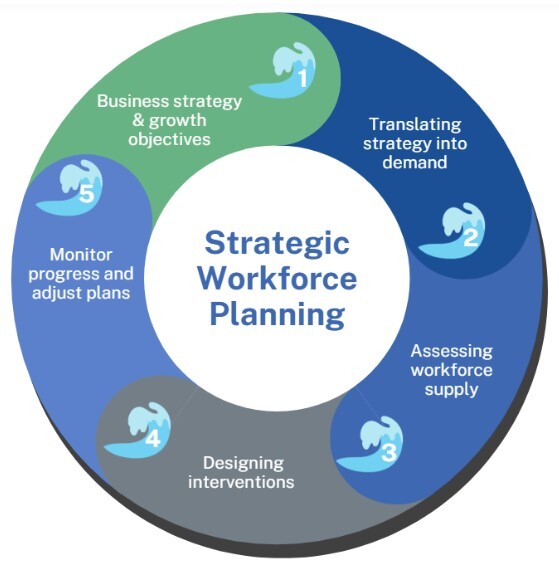
● Clear articulation of business strategy and growth objectives
● Translating strategy into workforce demand (roles, skills, capacity)
● Assessing current workforce supply while identifying gaps and surpluses
● Designing interventions: buy (hire), build (reskill/redeploy), borrow (outsource) or bot (automate)
● Consistently monitoring progress and adjusting plans
When done well, SWP enables organizations to:
● Reduce talent-related risk
● Improve financial performance and predictability
● Make smarter investment decisions
● Build resilience in the face of change
Yet despite its promise, SWP has struggled to gain widespread adoption. Many organizations still treat it as an annual exercise, a spreadsheet-based forecast, or a budgetary blueprint that is quickly put on a shelf and rarely revisited.
AI changes that reality, whether organizations are ready or not.
The Time is Now
Perhaps the most dangerous assumption organizations can make is that they have time. They do not. AI adoption is accelerating faster than most workforce strategies can adapt.
Organizations that delay will face:
● Critical skill shortages
● Rising labor costs with declining productivity
● Increased reliance on expensive external hiring
In the age of AI, SWP is not about predicting the future perfectly. It is about anticipating a variety of scenarios and acting quickly and confidently. Organizations that shed their antiquated strategies in favor of contemporary technologies and techniques will adapt faster than (and outperform) their competitors.
A Call to Action
The AI wave is not temporary. It will not reshape work at a comfortable pace. It will force organizations to confront fundamental questions about how value is created, and by whom (or what). Strategic workforce planning is the discipline that connects these questions to action. But only if it evolves.
Organizations must:
● Abandon static, role-based planning
● Embrace new ways of tracking and evaluating skills, tasks, and scenarios
● Leverage AI to automate administration and augment human decision-making
● Align HR, Finance, and IT around a shared workforce strategy
Management guru Peter Drucker suggested, “the best way to prepare for the future is to create it.”
If you are looking to merely survive the AI tsunami, you will undoubtedly find yourself underwater. So grab a surfboard (and a strong SWP partner) and ride the wave into the future.

About LYTIQS
LYTIQS helps organizations navigate this new reality. Our AI-enabled workforce analytics and strategic workforce planning solutions empower leaders to understand their workforce at a deeper level, model future scenarios, and make confident, data-driven decisions in an era of unprecedented change. The future of work is already here. Are you ready?