Artificial intelligence is already changing how work gets done. Yet in many organizations, workforce plans, performance metrics, and role expectations still reflect a pre-AI reality. Tools have been deployed, but the underlying design of work often remains untouched.
This creates a dangerous gap between technology investment and business value.
Strategic workforce planning can help close that gap but only if organizations begin asking different questions. Not just about adoption, but about how work, roles, and performance are fundamentally evolving.
Here are ten questions HR leaders should be asking now.
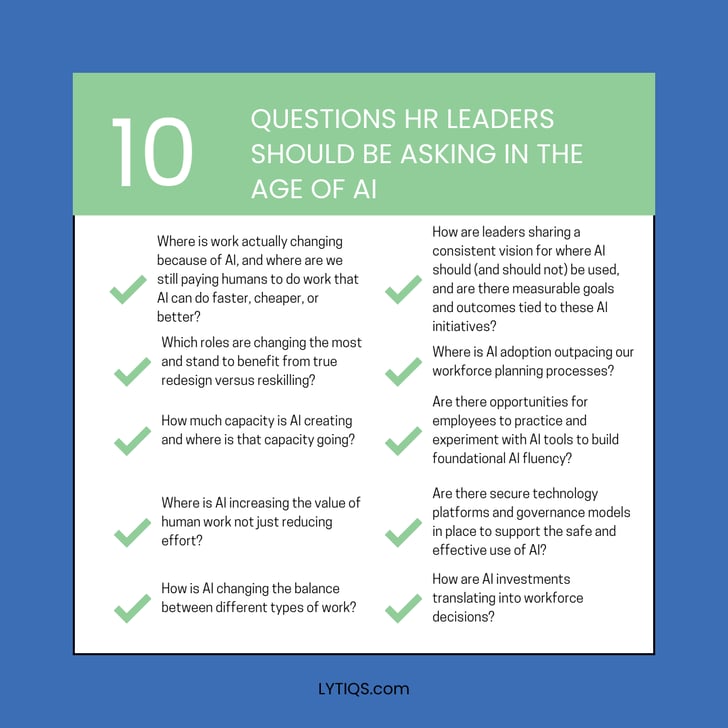
1. Where is work actually changing because of AI, and where are we still paying humans to do work that AI can do faster, cheaper, or better?
Many organizations have introduced AI tools without evaluating opportunities to redesign workflows, decision rights, or task allocation. This limits the potential impact.
True productivity gains rarely come from simply layering technology onto legacy processes. They come from rethinking how work itself gets done.
Across most organizations, there are still routine, repetitive, and rules-based tasks that consume valuable human capacity. Identifying and redesigning this work can directly improve cost structure, efficiency, and workforce effectiveness.
2. Which roles are changing the most and stand to benefit from true redesign versus reskilling?
AI often changes the mix of work long before it changes job titles. Employees may spend less time gathering information and more time interpreting it.
These shifts can quietly invalidate existing performance expectations, capacity assumptions, and workforce models. Training alone cannot solve structural changes in how work gets done.
In some cases, roles themselves must evolve. Recognizing when role redesign (not just skill development) is required helps ensure workforce investments translate into real performance improvements.
3. How much capacity is AI creating and where is that capacity going?
AI frequently unlocks time. But time saved does not automatically translate into value created.
That capacity can be absorbed by inefficiencies, redirected toward low-priority work, or intentionally reinvested in growth, innovation, and customer outcomes. Only the latter drives meaningful financial impact.
Understanding where capacity is going is as important as measuring how much is created.
4. Where is AI increasing the value of human work not just reducing effort?
AI is not only an efficiency tool. In many cases, it enhances human judgment, accelerates insight generation, and enables employees to operate at a higher level.
This can improve decision quality, strengthen customer relationships, and enable employees to contribute more strategically. These outcomes often matter more than simple time savings.
5. How is AI changing the balance between different types of work?
As AI handles more routine execution, human work increasingly shifts toward problem-solving, exception handling, oversight, and decision-making.
This may reduce the need for purely transactional roles while increasing demand for analytical, creative, and judgment-oriented capabilities. Over time, this reshapes hiring strategies, career paths, and organizational structures.
6. How are leaders sharing a consistent vision for where AI should (and should not) be used, and are there measurable goals and outcomes tied to these AI initiatives?
AI adoption is anchored in a clearly articulated enterprise narrative. What problems AI is meant to solve, where should human judgment remain non-negotiable, and how success will be defined.
That vision should cascade through leadership communications and be reinforced with measurable KPIs such as productivity gains, quality improvements, cycle-time reductions, or employee experience metrics.
Many performance systems still measure activity rather than outcomes, volume rather than impact, and individual output rather than human-AI effectiveness. When metrics fail to evolve alongside work, they can prevent organizations from realizing the full value of AI.
7. Where is AI adoption outpacing our workforce planning processes?
Technology often moves faster than planning cycles.
Functions may already be operating differently than workforce models assume. Job descriptions may no longer reflect reality. Headcount plans may be based on outdated productivity assumptions.
This misalignment can lead to overinvestment in some areas and shortages in others.
8. Are there opportunities for employees to practice and experiment with AI tools to build foundational AI fluency?
Many organizations fail to make room for their people to learn something new. AI proficiency is built through applied learning, not memos or mandates.
Safe sandboxes, pilot programs and use-case labs allow employees to experiment with new ways of working. This gives them the chance to practice and even play before AI is formally embedded into their daily work. Pairing this with formal learning and clear guardrails accelerates competence, confidence and responsible innovation.
9. Are there secure technology platforms and governance models in place to support the safe and effective use of AI?
Sustainable AI adoption requires enterprise-grade tools and technologies that allow role-based access, clearly defined data security protocols and formal integration standards. This includes the need for governance, risk and compliance capabilities to ensure data privacy, ongoing monitoring, model validation and vendor management to ensure compliant and ethical use.
This is where HR leaders should be partnering with IT and legal to formalize oversight, accountability and audit mechanisms.
10. How are AI investments translating into workforce decisions?
Every AI initiative has implications for roles, skills, capacity, and workforce mix. Yet these connections are often implicit rather than intentional.
Organizations that explicitly link AI adoption to workforce planning decisions such as hiring, redeployment, reskilling, and role redesign are far more likely to capture meaningful business value.
This is where technology investment becomes both operational and financial in impact.
A New Mandate for HR and Workforce Planning
These questions reflect a broader shift already underway.
Work is no longer defined solely by roles. It is defined by tasks, capabilities, and the dynamic interaction between humans and intelligent machines.
This requires workforce planning to evolve from a static, headcount-driven exercise into a continuous, data-informed discipline that connects technology, talent, and financial outcomes.
Organizations that ask and act on these questions will be better positioned to improve productivity, control costs, and unlock the full potential of their workforce.
Those that do not risk investing in AI without realizing its promise.
The technology may be new. But the mandate is familiar: align people, work, and strategy to create lasting value.
About LYTIQS
LYTIQS helps organizations navigate this new reality. Our AI-enabled workforce analytics and strategic workforce planning solutions empower leaders to understand their workforce at a deeper level, model future scenarios, and make confident, data-driven decisions in an era of unprecedented change. The future of work is already here. Are you ready?