
How AI Is Redesigning the Modern Organization
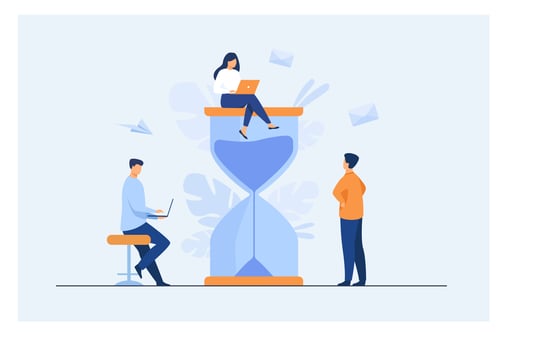
Roughly 4,500 years ago, the first pyramids appeared in Egypt, built by a massive skilled workforce that relied on levers, ramps and a whole lot of elbow grease. Over time, organizations adopted the pyramid as the standard hierarchical structure of choice. Entry-level workers made up the majority of the base, with middle level managers maintaining control and a select few executives at the top responsible for decision-making. As AI becomes more prevalent and starts to automate and augment the human workforce, some believe entry-level workers are at risk, with the resulting shape of the organization becoming more of a diamond. But the new shape of the organization is more likely to be an hourglass.
The entry-level extinction myth: the kids are alright
While much has been made about the potential disappearance of entry-level work, the reality is quite different. IBM announced earlier this year that they are tripling their entry-level hiring. At a recent conference, IBM Chief Human Resources Officer Nickle LaMoreaux suggested, “The companies three to five years from now that are going to be the most successful are those companies that doubled down on entry level hiring in this environment.”
The reality is that the next generation is the most adept at working alongside new technologies like AI, so they are well positioned to quickly adopt and embrace new ways of working that augment their abilities. And this group comprises the talent pipeline of the future, which is important when considering the need to prepare for upcoming workforce shortages.
While this lower-level work will not disappear, it will unquestionably evolve over time. Repeatable, transactional tasks will be automated by AI, while the workforce will remain responsible for two main functions:
1) Supervising technology to sustain productivity and
2) Problem solving based on context, situational awareness and adaptability
But humanity’s relationship with technology will not be that simple. In some cases, we will supervise AI while in others, AI will supervise us.
It will be the best of times… it will be the worst of times
Historically, as entry-level workers gain experience and capability, the highest performing individuals have been promoted into supervisory roles. While most of us aspire to grow in our careers, take on more responsibility and make more money – very few of us would suggest that we long to manage people. Fortunately for us, the very function of middle-management will be one of the fastest and simplest to automate away.
AI agents can easily monitor behavior, enforce policy compliance and provide reports to senior leadership regarding the performance of both individuals and the organization itself. Author and academic Erik Brynjolfsson suggests, “AI can be used to monitor workers in real time and make managerial decisions that were previously the domain of supervisors.” Organizations like Amazon and Meta have clearly indicated their desire to flatten their managerial layers, resulting in the span of control of human managers increasing over time.
The good news is that the new model of management will be more focused on relationships than regulations. Those pesky time cards, expense reports and even performance appraisals will all be administered by talent technology, leaving managers free to coach, counsel and connect with their people.
Amplification of accountability
In some respects, the role of management will move up a rung to the executive ranks. But instead of managing people, we may manage hundreds of AI agents and autonomous teams. This is less about supervision and more about orchestration of complex systems that include both people and technology.
As AI accelerates how quickly organizations can use real-time data to model scenarios and plan for the future, more individuals will be needed for high-stakes, real-time decision-making. While technology will further expand analysis, forecasting and optimization, humans must remain accountable and responsible for ethical judgement. Microsoft CEO Satya Nadella frames AI as a “cognitive amplifier” and emphasizes the need for human ownership of outcomes.
Contemporary constructs at work
The pyramids were built for a different era and relied upon manual labor for the completion of the majority of their structure. Workers at that time would likely have been eager to trade their physically exhausting roles to be an AI prompt engineer or a social media strategist. But those jobs did not exist back then, and new jobs that are difficult to imagine will soon appear on the horizon. Will the hollowing out of the middle of most organizations be welcomed or warned against? It will likely depend on how entry-level employees jump the missing middle rung to get to the executive ranks.