Most organizations are concentrating on how AI will impact jobs. Far fewer are focused on how AI has already transformed the workforce planning process itself. This is a critical oversight.
That world no longer exists. AI introduces three forces that fundamentally undermine legacy workforce planning approaches
AI foundationally changes SWP in three important ways:
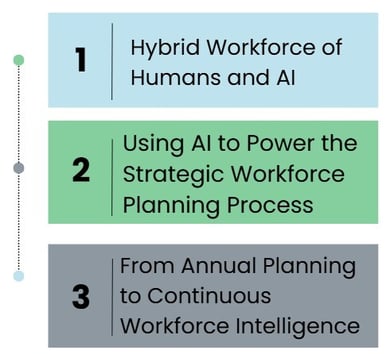
1. Hybrid Workforce of Humans and AI
The central workforce planning question is no longer, “How many people do we need?” It has evolved into:
● Which work should be done by humans?
● Which work should be done by AI?
● Which work should be done by humans augmented by AI?
This requires a deliberate move from role-based planning to work architecture planning, including:
● Comprehensive skill and task inventories
● Skill adjacency mapping (think transferable skills for internal mobility)
● Analysis of potential to automate and augment
The high-level topic of “skills” was all the rage in the HR technology market a few years ago and then seemingly they fell out of favor. There seems to be a bit of a resurgence of interest, with organizations acknowledging their need to understand the human skills that will still be needed as AI takes on more of the administrative, transactional tasks that we do today. And organizations are now able to go well beyond self-reported skills thanks to companies like Skillfully that utilize AI simulations to validate real skills of employees and applicants.
Organizations that fail to plan for this hybrid workforce will overinvest in labor, underutilize AI, or both. From a financial perspective, this also reframes workforce cost structures. Labor is no longer a fixed expense line. It is a dynamic mix of human effort and technology-enabled digital labor, resulting in unparalleled productivity gains.
2. Using AI to Power the Strategic Workforce Planning Process
Ironically, while many organizations fear AI’s impact on jobs, they are dramatically underutilizing AI in the SWP process itself. Modern AI-enabled strategic workforce planning platforms can aggregate and normalize data across HR, finance, operations, and technology systems. This helps to identify patterns and correlations humans commonly miss.
A compelling new capability is the automatic generation of strategic workforce plans. SWP has historically been avoided because it was extremely labor intensive and dependent on fragmented data.
LYTIQS can generate an initial strategic workforce plan in hours, not months. Enabling leaders to model multiple scenarios quickly and confidently.
Eventually one of the biggest benefits of using AI in this process will be the use of natural language to conversationally access workforce insights, with questions like:
● “What happens to our workforce cost and skill mix if AI automates 20% of finance operations?”
● “What departments are experiencing the most voluntary turnover, and what are the likely underlying causes?”
● “What skills will we lack in 24 months if we do not reskill our current workforce?”
This transforms workforce planning from an occasional reporting exercise into an ongoing decision-support capability while speaking to the system like you would to Siri or Alexa.
3. From Annual Planning to Continuous Workforce Intelligence
AI enables continuous monitoring and adjustment rather than static annual plans. This is essential in an environment where:
● Business strategies shift rapidly
● Labor markets fluctuate
● Technology adoption accelerates
Research from HR.com shows organizations that embed workforce analytics into ongoing decision-making are significantly more likely to outperform peers in productivity, engagement, and financial performance. In the AI era, workforce planning must function more like a navigation system than a roadmap -continuously recalculating as conditions change and destinations fluctuate.
Across the research landscape, a consistent message is emerging: SWP is becoming more integrated, more data-driven, and more urgent. While interest in workforce analytics is high, execution maturity remains low -creating an opportunity gap for organizations willing to invest. The implication is stark. Organizations that build advanced SWP capabilities will gain a structural advantage. Those that do not will find themselves in a perpetually reactive cycle.
The Time is Now
Perhaps the most dangerous assumption organizations can make is that they have time. They do not. AI adoption is accelerating faster than most workforce strategies can adapt.
Organizations that delay will face:
● Critical skill shortages
● Rising labor costs with declining productivity
● Increased reliance on expensive external hiring
In the age of AI, SWP is not about predicting the future perfectly. It is about anticipating a variety of scenarios and acting quickly and confidently. Organizations that shed their antiquated strategies in favor of contemporary technologies and techniques will adapt faster than (and outperform) their competitors.
A Call to Action
The AI wave is not temporary. It will not reshape work at a comfortable pace. It will force organizations to confront fundamental questions about how value is created, and by whom (or what). Strategic workforce planning is the discipline that connects these questions to action. But only if it evolves.
Organizations must:
● Abandon static, role-based planning
● Embrace new ways of tracking and evaluating skills, tasks, and scenarios
● Leverage AI to automate administration and augment human decision-making
● Align HR, Finance, and IT around a shared workforce strategy
Management guru Peter Drucker suggested, “the best way to prepare for the future is to create it.”
If you are looking to merely survive the AI tsunami, you will undoubtedly find yourself underwater. So grab a surfboard (and a strong SWP partner) and ride the wave into the future.

About LYTIQS
LYTIQS helps organizations navigate this new reality. Our AI-enabled workforce analytics and strategic workforce planning solutions empower leaders to understand their workforce at a deeper level, model future scenarios, and make confident, data-driven decisions in an era of unprecedented change. The future of work is already here. Are you ready?
About Marcus Mossberger
Marcus is genuinely passionate about elevating humanity’s experience at work. He has spent several decades deciphering the various challenges and opportunities related to the world of work and today is focused on bringing that knowledge to bear by helping organizations chart a path forward. His focus at LYTIQS is to channel his market perspective into the strategy and execution of LYTIQS offerings, with the goal of building and delivering what matters most to their customers and partners.